Sintra is, by any measure, one of the most extraordinary places in Europe. A UNESCO World Heritage Site tucked into the forested foothills of the Serra de Sintra, 25 kilometres west of Lisbon, it manages to concentrate more architectural beauty, historical drama, and natural wonder into a few square kilometres than most cities achieve across entire centuries. Pena Palace alone would justify a visit from anywhere in the world. The fact that it shares its hillside with four other palaces, a Moorish castle, terraced gardens, and one of Portugal's most beguiling villages makes Sintra genuinely difficult to leave.
The question is not whether to visit. It is how. The Serra is generous with its rewards, but it can also overwhelm: a single day that tries to take in everything tends to leave visitors tired and only half-present in any of the places they have been. This guide is designed to help you choose well, move efficiently, and arrive at each site in the right frame of mind — which is to say, unhurried.
Visit Pena Palace — the Palace That Started It All
For most visitors, a trip to Sintra begins and ends with Palácio Nacional da Pena, and with good reason. Built between 1842 and 1854 on the ruins of a medieval convent, Pena is the defining monument of Portuguese Romantic architecture — a fantastical confection of battlements, towers, terraces, and archways painted in the original colours of deep terracotta red and bright ochre yellow that King Ferdinand II chose to distinguish its two wings. It looks, in the best possible way, as though someone with unlimited resources and a deep love of fairy tales had been given a mountaintop and told to do their worst.
The palace interior rewards careful attention: the Arab Room, with its arabesque plasterwork and silk furnishings, the kitchen with its original 19th-century copper equipment, and the vast Ballroom with its painted ceilings all speak to a court that understood comfort as an art form. But it is the exterior — the ramparts, the Triton Arch, the view from the upper terrace across the Serra to the Atlantic — that visitors remember most.
Book tickets online well in advance, particularly between May and September, and arrive at opening time (9:30am). The palace is a 30-minute walk uphill from the town centre, or a short tuk-tuk ride. The surrounding Pena Park — 200 hectares of landscaped parkland with lakes, valleys, and an extraordinary collection of exotic trees — is included in the palace ticket and rewards an hour of quiet exploration after the rooms.
Explore Quinta da Regaleira — the Sintra You Were Not Expecting
If Pena Palace is Sintra's most famous attraction, Quinta da Regaleira is its most mysterious. Built at the turn of the 20th century for the eccentric and tremendously wealthy António Augusto Carvalho Monteiro, the estate is saturated with Masonic, Rosicrucian, Kabbalistic, and alchemical symbolism encoded into every arch, tile, and garden feature.
The palace itself is a theatrical tour de force of neo-Manueline stonework: gargoyles, dragons, twisted columns, and emblems carved from pale stone that seems to glow in the morning light. The chapel is extraordinary — its ceiling a mosaic of religious and esoteric symbols. But Quinta da Regaleira's masterpiece is its gardens. Carved from dense hillside woodland, they reveal their secrets gradually: grottos, lakes, a chapel in the trees, underground tunnels that connect one part of the estate to another.
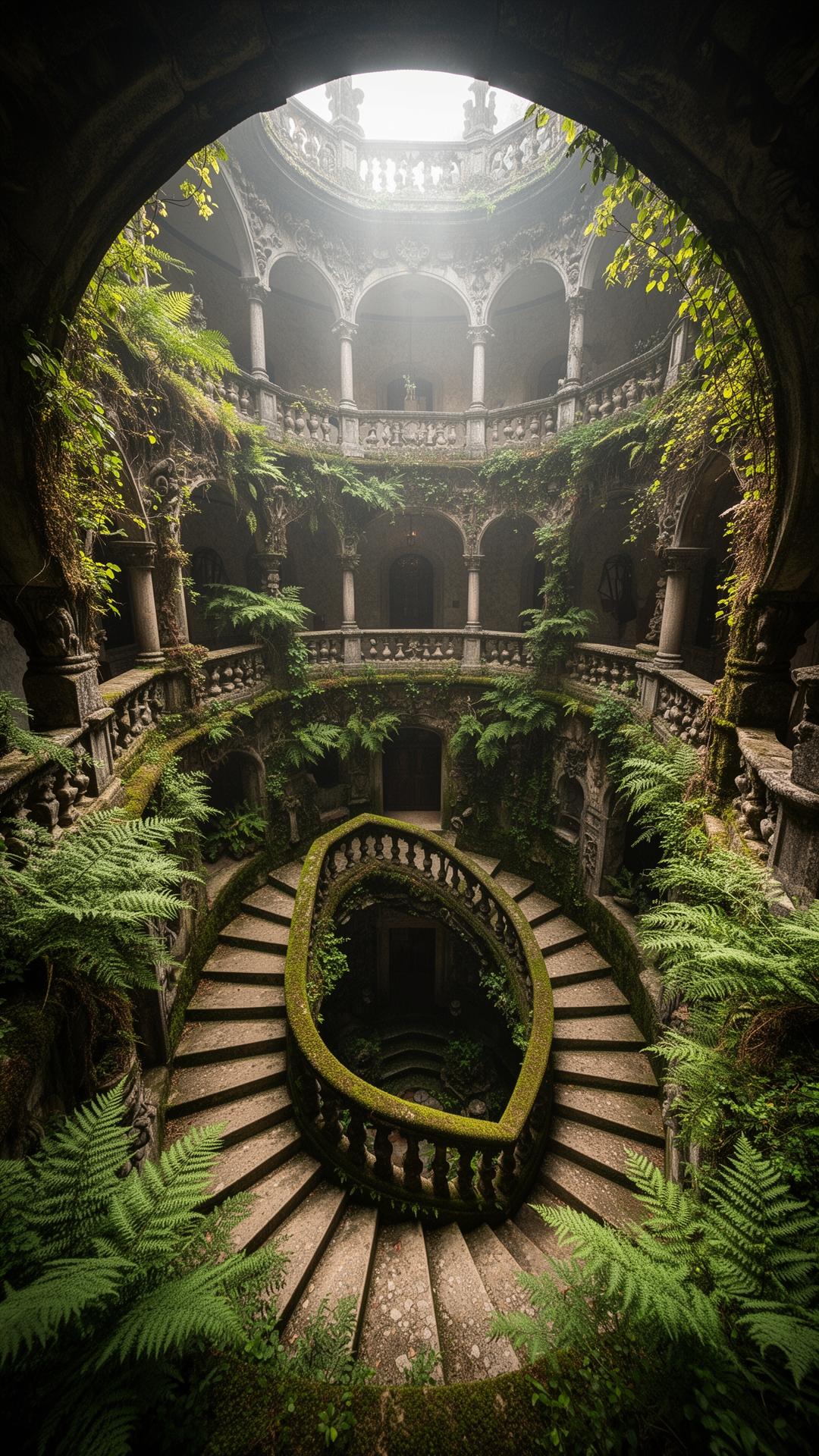
At the centre of it all is the Poço Iniciático — the Initiation Well — a nine-storey spiral staircase that descends 27 metres into the earth. It was built not for water but for ceremony: initiates were lowered blindfolded to the base and found their way back to the surface through the tunnels, as a test of inner resolve. Today, visitors descend by torchlight and emerge, somewhat disoriented, into the gardens above. Book tickets in advance and allow at least two hours.
Walk the Moorish Castle — 1,300 Years of History
The Castelo dos Mouros is the oldest monument in Sintra, and the most elemental. Built by the Moors in the 8th and 9th centuries and captured by Afonso Henriques, Portugal's first king, in 1147, the castle's crenellated walls climb across the rocky ridgeline of the Serra in a dramatic line that has been visible from the plains below for more than a thousand years.
Today, visitors walk the restored battlements, climb the towers, and take in views that, on a clear day, extend south to Lisbon and the Tagus estuary, west to the Atlantic, and north across the Serra to the mountains beyond. The views from the Royal Tower — the castle's highest point — are the finest in all of Sintra. The Moorish Castle and Pena Palace share a forest path between them and most visitors do both on the same morning, which is the natural order.
See the National Palace of Sintra — Beauty in Plain Sight
Standing in the centre of Sintra village, its two enormous conical chimneys visible from the surrounding hills, the Palácio Nacional de Sintra is the oldest surviving royal residence in Portugal and, curiously, the one that most visitors walk past without fully noticing. This is a mistake.
The palace interior is magnificent. The Sala dos Brasões, its domed ceiling covered in 72 armorial shields representing the noble families of 16th-century Portugal, is one of the finest rooms in the country. The Sala das Pegas — the Magpie Room — is decorated with 136 magpies, each holding in its beak a rose and a banner reading por bem (for good), commissioned by King João I after being caught by the queen in the act of kissing a lady of the court. The azulejo tile panels throughout are among the best examples of Portuguese decorative art anywhere in the country. Far less visited than Pena or Regaleira, the National Palace can often be explored at leisure, without competition.
Discover Monserrate — Sintra's Finest Secret
Three kilometres west of the town centre, Palácio de Monserrate is the most beautiful and least-visited of Sintra's great palaces — the place where the most discerning visitors tend to end up.
Rebuilt between 1858 and 1885 for the English merchant Sir Francis Cook, on a site that had already captivated both William Beckford and Lord Byron, the building is an extraordinary synthesis of Gothic, Moorish, and Indian architectural influences. Its exterior is carved in pale stone that clings to the hillside above a lake and a formal garden; its interior features plasterwork of Alhambra-like intricacy, recently restored after decades of neglect.
The surrounding 35-hectare garden is Monserrate's real treasure: tree ferns from New Zealand, cycads from South Africa, Himalayan rhododendrons, Mexican palms, and countless other specimens arranged along paths that wind through the hillside woodland. In spring, the rhododendrons are extraordinary. At any time of year, an hour in Monserrate's garden feels more restorative than an afternoon anywhere else in Sintra. Arrive by tuk-tuk in the early afternoon, when the morning crowds have thinned, and give yourself at least 90 minutes.
Wander Sintra Village — Pastries, Wine, and Cobbled Streets
Between palace visits, Sintra's historic village centre rewards an unhurried hour or two. The streets around the Praça da República — the main square, flanked by the National Palace — are lined with small restaurants, wine bars, and craft shops. The atmosphere in the morning before the day-trippers arrive is quiet and particular: mist in the narrow lanes, the sound of distant bells, the smell of warm pastry.
Stop at Piriquita, on Rua das Padarias, which has been making Sintra's two great pastries since 1862. The travesseiro — a pillow of flaky pastry filled with almond cream and icing sugar — is the thing to order first. The queijada — a small tart of fresh cheese, eggs, and cinnamon — is the other. Eat them warm, at the counter, and then order another.
For lunch, Tascantiga offers excellent Portuguese small plates. For something more considered, Incomum by Luis Santos provides creative modern Portuguese cooking worth booking in advance. At any wine bar you visit, look for Colares on the list: produced from ancient ungrafted vines in the sandy coastal soils west of Sintra, it is one of Portugal's rarest wines and one you are unlikely to encounter anywhere else.
Drive to Cabo da Roca and the Atlantic Coast
Most visitors to Sintra never make it to the coast, which is their loss. A 25-minute drive west of the town brings you to Cabo da Roca — the westernmost point of continental Europe, a sheer cliff above an Atlantic that stretches, uninterrupted, to the Americas. There is a lighthouse, a small visitor centre, and very little else. The view is everything.
From Cabo da Roca, the coastal road south leads through Azenhas do Mar — a cluster of whitewashed houses stacked against a cliff above a natural swimming pool, one of the most photographed places on the Portuguese coast — and continues to Cascais. The road north passes through the extraordinary coastal cliffs of the Parque Natural de Sintra-Cascais, one of the finest stretches of protected Atlantic coastline in Iberia.
Plan to finish your Sintra day at Cabo da Roca in the late afternoon, when the light turns copper and the wind drops. It is one of those places that makes the distance you have travelled feel, briefly, absolutely worth it.
When to Visit Sintra and How to Get There
The best months to visit Sintra are April, May, September, and October: the crowds are manageable, the Serra is green and flowering, and the Atlantic light is at its most beautiful. July and August are warm and very busy. November through March is quieter and frequently dramatic: the Serra mist can reduce visibility to a few metres, which gives the palaces an otherworldly atmosphere that summer visitors never see.
Sintra is 25 kilometres from Lisbon. By train: Rossio station runs direct services every 30 minutes; the journey takes 40 minutes and costs around €4.40 return. The first service leaves before 7am — the ideal departure for an early start. By car: the A37 is fast and straightforward, with parking in the lower town. By private tour: most visitors combining Sintra with Cascais, Cabo da Roca, or Colares find a private day tour the easiest option — it removes the logistics of moving between sites and allows the itinerary to adapt to your pace.
Book all the major palaces — Pena, Regaleira, Monserrate, the Moorish Castle, and the National Palace — online in advance during peak season. Walk-up queues can add an hour or more to your morning, and for Pena and Regaleira, tickets frequently sell out days ahead.
Explore Sintra with a Private Guide
A private guide makes a significant difference in Sintra. Not because the palaces require explanation — they do not — but because knowing which entrance at Pena avoids the main queue, which path through Regaleira's tunnels to take first, where the light falls best on Monserrate's façade in the early afternoon: these are things that take years to learn and half a day to appreciate.
Our bespoke Sintra tours are designed around the way we believe a day in the Serra should feel: unhurried, well-sequenced, and genuinely informed by the history and character of each place you visit. We handle tickets, transport, and timing. You bring the curiosity.
Contact us to plan your private tour of Sintra, or explore our guide to the castles and palaces of Sintra for more on what awaits in the Serra.