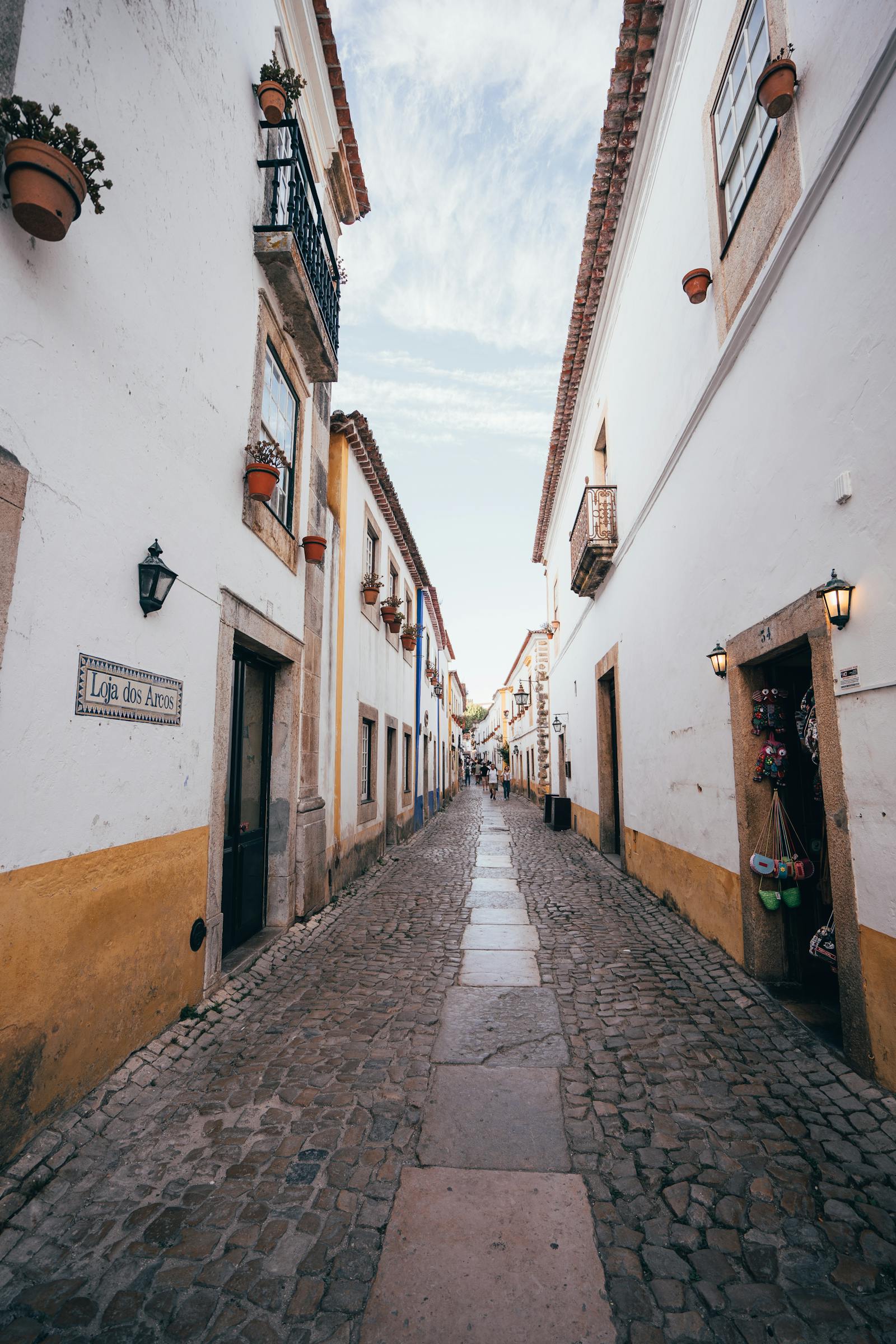
The queen's wedding gift
In 1282, King Dinis gave Óbidos to his new wife, Queen Isabel, as a wedding present — and for the next five centuries it remained a royal possession, which explains why so much of it survives intact. The walls, first built by the Moors and reinforced by successive Christian kings, form a complete circuit around the village. You can walk the full perimeter on top of them, looking down over terracotta rooftops, bougainvillea and the Óbidos lagoon beyond.
Inside the walls
The main street, Rua Direita, runs the length of the old town in a gentle curve of whitewashed houses trimmed with blue and yellow. Every doorway seems to frame a different arrangement of geraniums and stone. The castle at the top has been converted into a pousada — one of Portugal's most atmospheric hotels — but the keep and towers remain open to explore. The Church of Santa Maria, where the ten-year-old King Afonso V married his eight-year-old cousin in 1444, faces a small square shaded by trees.
Ginjinha de Óbidos
The town's most famous product is ginjinha — a liqueur made from sour morello cherries steeped in aguardente, sweet and faintly resinous. In Óbidos it is traditionally served in a small chocolate cup, which you eat afterwards. The cherry orchards that surround the town produce the fruit from May onwards, and the Óbidos Chocolate Festival in March draws the crowds early in the year.
The lagoon and surroundings
The Óbidos lagoon — a large brackish lake separated from the Atlantic by a narrow sandbar — offers birdwatching, kayaking and excellent seafood at the villages on its shores. Caldas da Rainha, ten minutes north, is a lively market town famous for its pottery and its thermal spa, founded by Queen Leonor in 1484.
Day trip from Lisbon
Óbidos is eighty kilometres north of Lisbon — an hour by road — and pairs naturally with Nazaré, Alcobaça or Batalha for a full day in the Silver Coast region. We can tailor an itinerary that combines all four without feeling rushed.