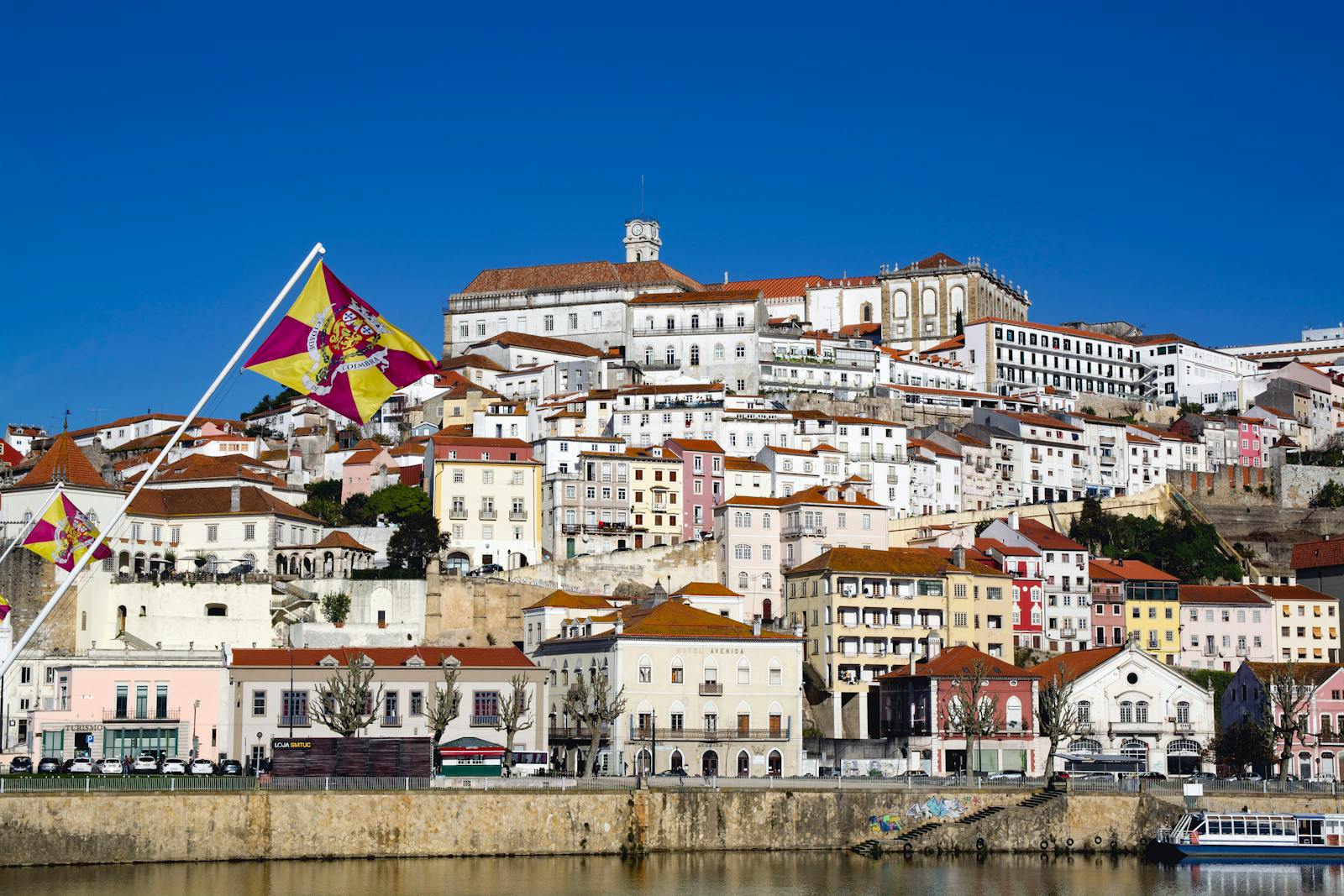
Portugal's university city
Coimbra occupies a hill above the River Mondego at roughly the geographic heart of Portugal, and for much of the country's history it was its cultural and intellectual centre. The University of Coimbra, founded in Lisbon in 1290 and moved here permanently in 1537, is today a UNESCO World Heritage Site — and still very much in use. Walking its courtyards feels like interrupting eight centuries of unbroken conversation.
The Joanina Library
No building in Portugal prepares you quite like the Biblioteca Joanina. Built between 1717 and 1728, it is three interconnected rooms of gilded Baroque excess — painted ceilings, lacquered bookcases stacked to the cornices, the smell of old paper and beeswax — and some 70,000 volumes, including manuscripts that have not been opened in generations. The university keeps a colony of bats in residence after dark; they eat the insects that would otherwise destroy the books.
Fado de Coimbra
Where Lisbon's fado is sung with raw emotion by women in black shawls, fado de Coimbra is quieter, more cerebral, traditionally sung only by men in academic capes. It emerged from the university's student culture and carries a particular melancholy — less about lost love than about the passage of time. Hearing it performed in a candlelit tasca below the old city is one of Portugal's most affecting experiences.
The old city
The Almedina arch marks the entrance to the old Moorish quarter, a tangle of lanes climbing to the university. Romanesque and Gothic architecture punctuate the ascent — the old cathedral (Sé Velha) dates from 1184 and remains one of Portugal's finest Romanesque buildings. Below, the lower town's café culture centres on Praça do Comércio and the riverside promenade, where students have gathered for generations.
The Mondego and Conimbriga
The river itself is worth an afternoon — hired punts, riverside restaurants and, downstream, the village of Penacova with its sweeping valley views. Fifteen kilometres south, the Roman ruins of Conimbriga are among the best-preserved in the Iberian peninsula, with extraordinary mosaic floors largely open to the sky.
Getting there
Coimbra sits midway between Lisbon (two hours by train or road) and Porto (one hour). It works well as a day trip from either city or as an overnight stop on a journey north.