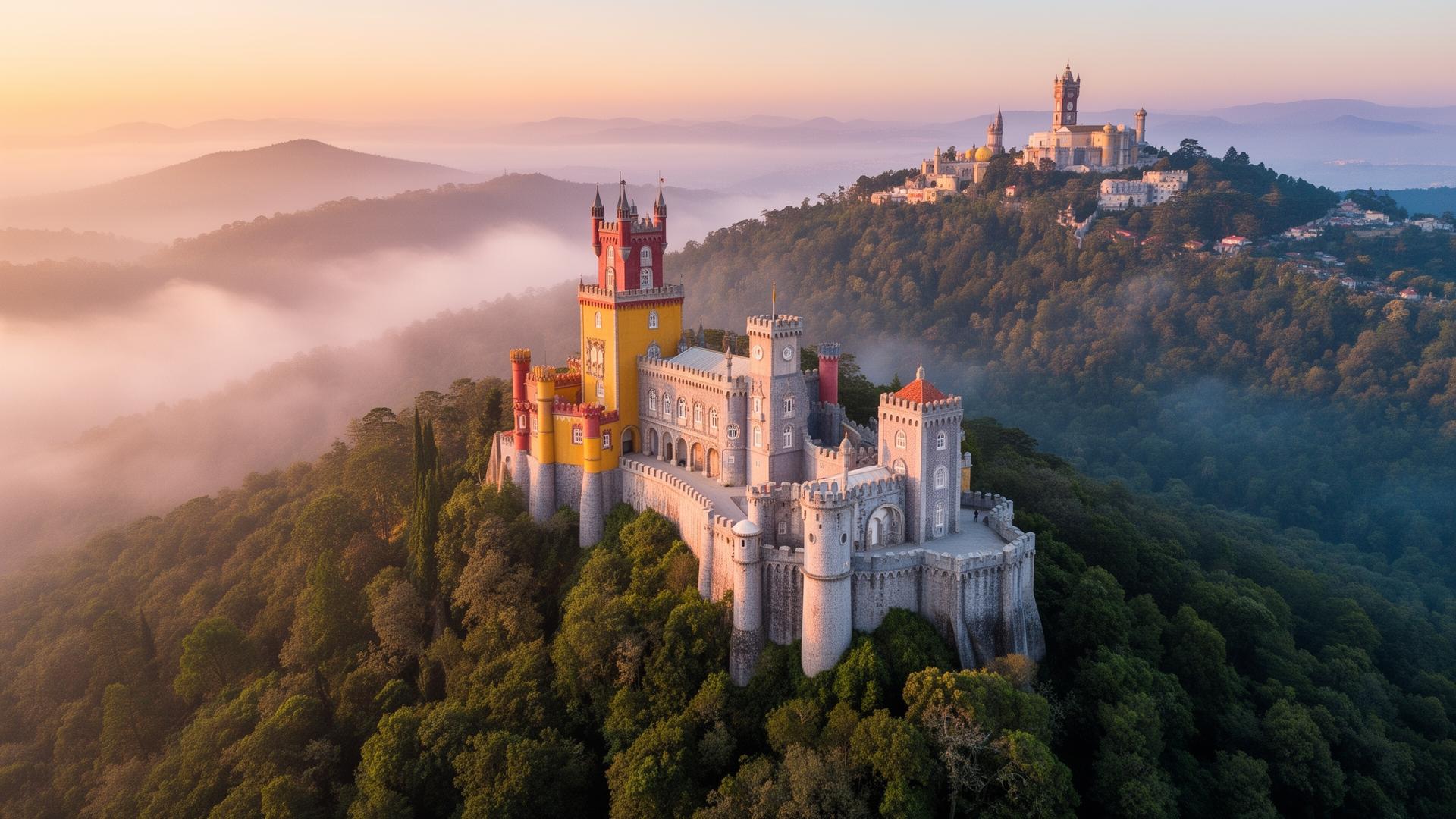
There is a moment, usually just after the morning mist lifts from the Serra de Sintra, when the Palácio da Pena appears above the treeline like something conjured from a dream — its turrets painted scarlet and ochre against a sky that has not yet decided whether to be gold or grey. It is the kind of sight that makes you understand, immediately, why Lord Byron called this place "the most beautiful in all the world."
Sintra is one of Portugal's most visited destinations, and with good reason. A UNESCO World Heritage Site since 1995, this small town in the foothills of the Serra rewards visitors with an extraordinary concentration of Romantic-era palaces, baroque gardens, and Moorish ruins — all within a few kilometres of each other, all wrapped in the particular green quiet of Portugal's Atlantic forest. The challenge is not finding things to do. It is doing them in the right order, at the right time, before the tour coaches arrive.
This itinerary has been refined over many years of guiding private tours through the Serra. It is designed to give you the best of Sintra in a single day — arriving early enough to feel the palaces belong to you, and leaving late enough to watch the light go golden over the Atlantic.
Why Sintra Rewards Those Who Rise Early
The single most important decision you can make when planning a day trip to Sintra from Lisbon is your departure time. By ten o'clock in the morning, the cobbled streets around the historic centre are filling with day-trippers; by eleven, Pena Palace has queues stretching down the hillside. The palaces themselves open at 9:30am. Aim to be standing at the gates before they unlock.
If you are driving from Lisbon — roughly 30 minutes on the A37 — you will find parking in the lower town considerably easier before nine. If you are taking the train, the first service from Rossio station departs just after 7am, with the journey taking around 40 minutes and costing approximately €4.40 return. Either way, an early start is not a sacrifice. It is the difference between Sintra as it ought to be experienced and Sintra as most people endure it.
Morning: Pena Palace and the Moorish Castle
Begin at Palácio Nacional da Pena, and take your time. Built between 1842 and 1854 for King Ferdinand II — himself an artist and passionate Romanticist — Pena is one of the finest examples of 19th-century Romantic architecture anywhere in Europe. Its colours alone are startling: the palace is divided between a deep terracotta red and a vivid yellow ochre, separated by battlements and balustrades adorned with Manueline carvings, Moorish arches, and neo-Gothic towers. Walking through it feels less like visiting a museum and more like wandering through the imagination of someone who had read too many fairy tales and had the money to build one.
From the upper ramparts, on a clear morning, the views extend across the Serra to the Atlantic and south towards Lisbon and the Tagus. Spend an hour here, then follow the forest path — it takes about fifteen minutes on foot — to the Castelo dos Mouros. This Moorish fortification dates from the 8th and 9th centuries and was captured by Afonso Henriques, Portugal's first king, in 1147. Its crenellated walls climb across the hilltop in a long, dramatic line, and the views from the towers are, if anything, even more expansive than those from Pena. Arrive here by eleven and you will still have it largely to yourself.
Late Morning: Quinta da Regaleira
Descend from the castle and make your way to Quinta da Regaleira — the most mysterious and, for many visitors, the most memorable of Sintra's palaces. Built at the turn of the 20th century for the eccentric millionaire António Augusto Carvalho Monteiro, the estate is saturated with Masonic, Rosicrucian, and alchemical symbolism. The palace itself is a theatrical confection of neo-Manueline stonework: gargoyles, twisted columns, and emblems that repay careful study. But it is the gardens that make Regaleira unforgettable.
Hidden among paths that wind through dense woodland are a sequence of extraordinary features: a chapel, a lake, a grotto, and — the centrepiece — the Poço Iniciático, or Initiation Well. This is not a functional well but a ceremonial one, a nine-storey spiral staircase that descends 27 metres into the earth, its walls lined with carved stone landings and lit, on clear days, by a circle of sky far above. Initiates were lowered blindfolded to the base as part of Carvalho Monteiro's private rituals. Today, visitors descend on foot and emerge through underground tunnels into the gardens above. Allow at least 90 minutes for the whole estate, and book tickets online in advance — Regaleira frequently sells out.
Lunch in Sintra Village
By early afternoon you will be ready to eat, and Sintra's historic village — a ten-minute walk or short tuk-tuk ride from Regaleira — is the right place to do it. Before anything else, stop at Piriquita on Rua das Padarias, a bakery that has been producing Sintra's two great pastries since 1862: the travesseiro, a pillow of flaky pastry filled with almond cream and icing sugar, and the queijada, a small tart of fresh cheese, eggs, and cinnamon. Eat them still warm, standing at the counter.
For lunch proper, Tascantiga offers excellent Portuguese small plates in a relaxed setting, while Incomum by Luis Santos provides something more considered — a creative Portuguese menu that takes the region's ingredients seriously. Book ahead for the latter; it fills quickly. A glass of Colares wine, produced from ungrafted vines grown in the sandy coastal soils west of Sintra, is worth seeking out if you encounter it on any menu: it is one of Portugal's rarest and most distinctive wines, and you are unlikely to find it anywhere else.
Afternoon: Monserrate Palace and Gardens
Most day-trippers, by mid-afternoon, are already making their way back to the train station. This is exactly the right time to visit Palácio de Monserrate — the least-known and, arguably, the most beautiful of Sintra's palaces.
Monserrate was rebuilt in its current form between 1858 and 1885 for the English merchant Sir Francis Cook, on a site that had already attracted both William Beckford and Lord Byron earlier in the century. The palace is an extraordinary fusion of Moorish, Gothic, and Indian influences, its interior featuring delicate plasterwork that rivals the Alhambra in its intricacy. But it is the 35-hectare garden surrounding it that makes the visit extraordinary: a deliberately cultivated wilderness of exotic species — tree ferns, cycads, Himalayan rhododendrons, Mexican palms — arranged along winding paths that reveal new surprises at every turn. In spring, the garden is riotous with colour. In autumn, it settles into something quieter and more contemplative. In any season, it is one of the great gardens of Europe.
Monserrate sits about three kilometres west of the town centre. A tuk-tuk from the village square takes around ten minutes.
As the Day Ends: Cabo da Roca or a Quiet Return
If the day still has light in it, consider driving a further twenty minutes west to Cabo da Roca, the westernmost point of continental Europe. There is no monument to rival the palaces — just a lighthouse on a cliff above a sea that stretches, uninterrupted, to the Americas. In late afternoon, when the Atlantic turns copper and the wind drops, it is one of those places that makes you feel the full weight of where you are standing.
Alternatively, return to Sintra village and do what the locals do in the early evening: find a table outside one of the small wine bars near the Palácio Nacional de Sintra, order a local cheese board and a carafe of vinho verde, and let the day settle. The last trains back to Lisbon run until around midnight. There is no hurry.
How to Make the Most of Your Day in Sintra
A few practical notes before you go. Book Pena Palace and Quinta da Regaleira online before your visit — both sell out regularly in high season, and queue times for walk-up tickets can add an hour or more to your morning. Wear comfortable shoes: the paths between the palaces are steep and often cobbled. The best months to visit are April, May, September, and October, when the crowds are thinner and the Serra is at its most lush. July and August are warm and busy; winter is quieter and often dramatically misty, which has its own appeal.
If you would prefer not to navigate timetables, queues, and the logistics of moving between sites on your own, a private guided tour from Lisbon makes the day considerably easier. Our bespoke Sintra tours are led by expert local guides who know when the light falls right on Pena's battlements, which path through Regaleira's tunnels to take first, and where to find a quiet table for lunch. We handle the tickets, the transport, and the timing — leaving you free to simply be in one of the most remarkable places in Portugal.
Sintra asks only that you give it a full day and arrive before the crowds do. In return, it offers something you will not find in many places: the persistent, slightly disorienting sense that the real world has been temporarily suspended, and that anything — palaces in the mist, spiralling wells, gardens that go on forever — is entirely possible.
Contact us to plan your private tour of Sintra, or explore our guide to the castles and palaces of Sintra for more on what awaits in the Serra.