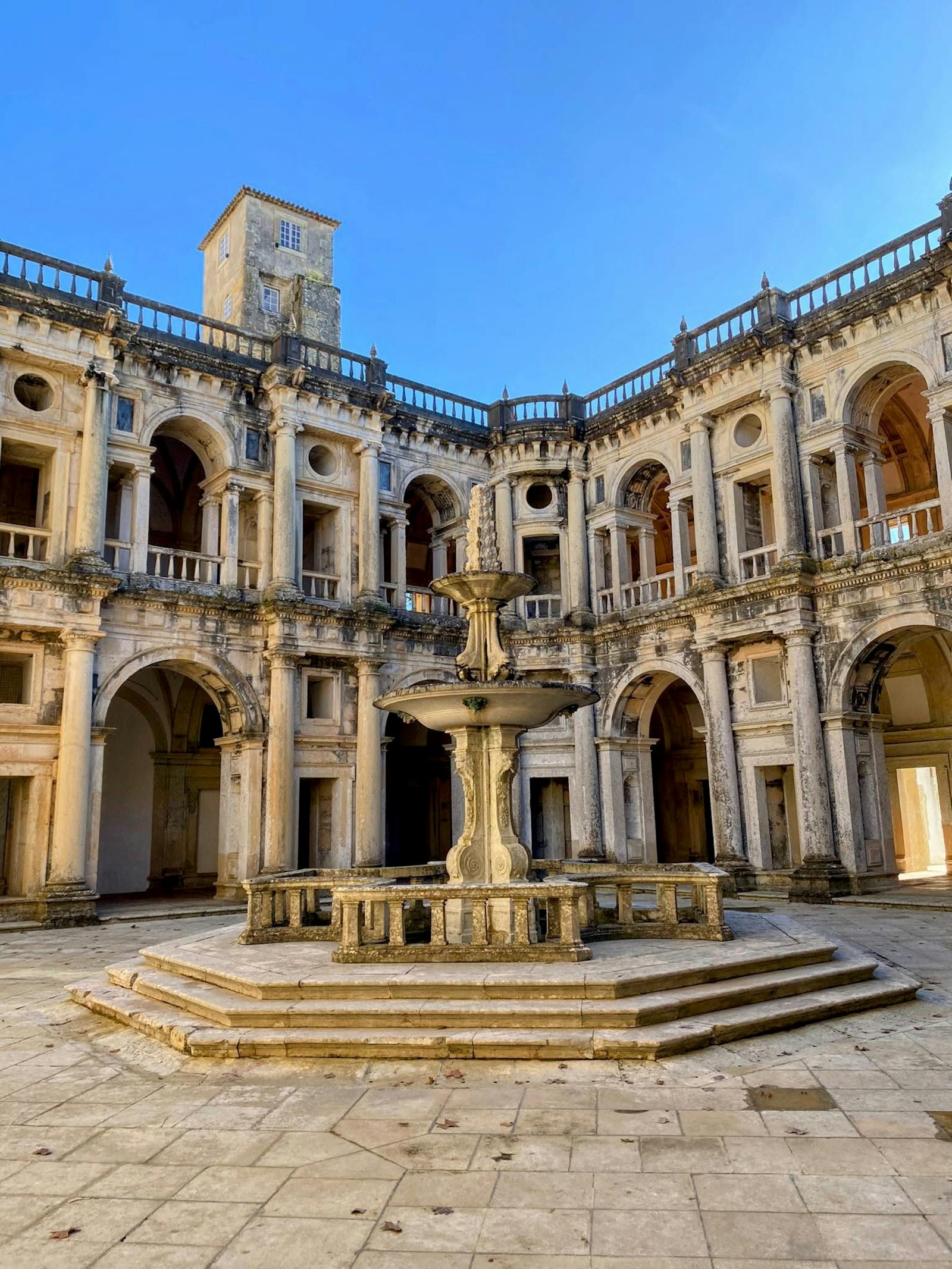
The Templar stronghold
Tomar was founded in 1160 by Gualdim Pais, first Grand Master of the Portuguese Knights Templar, who chose a hilltop above the River Nabão and began building what would become one of the most architecturally extraordinary complexes in Europe. The Convent of Christ — a UNESCO World Heritage Site — grew over five centuries, accumulating Romanesque, Gothic, Manueline and Renaissance layers as successive kings expanded and embellished it. No single visit feels sufficient.
The Charola
At the heart of the convent is the Charola, the original Templar oratory — a sixteen-sided Romanesque rotunda modelled loosely on the Holy Sepulchre in Jerusalem. The knights worshipped on horseback here, riding in through the entrance as a matter of ritual. The interior retains fragments of its original painting, and the proportions — monumental yet intimate — have an authority that later additions only intensify.
The Manueline window
The west window of the Chapter House, built under Manuel I in the early 16th century, is the defining image of Manueline architecture — a frame of sculpted stone incorporating anchors, coral, rope, armillary spheres and the cross of the Order of Christ in a composition so dense it takes several minutes simply to read. It is one of the most reproduced images in Portuguese art history, and more impressive in person than any photograph suggests.
The town
Below the convent, Tomar is a quietly prosperous market town of parks, restaurants and a lively central square. The Nabão divides it into old and new quarters, connected by a graceful medieval bridge. In even-numbered years, the Festa dos Tabuleiros — one of Portugal's most ancient and spectacular festivals — fills the streets with young women carrying elaborate headdresses of bread and paper flowers stacked two metres high.
Getting there
Tomar is 140 kilometres north of Lisbon, and combines naturally with Fátima (25 kilometres south) and the abbeys of Batalha and Alcobaça for a full day exploring Portugal's medieval heartland.