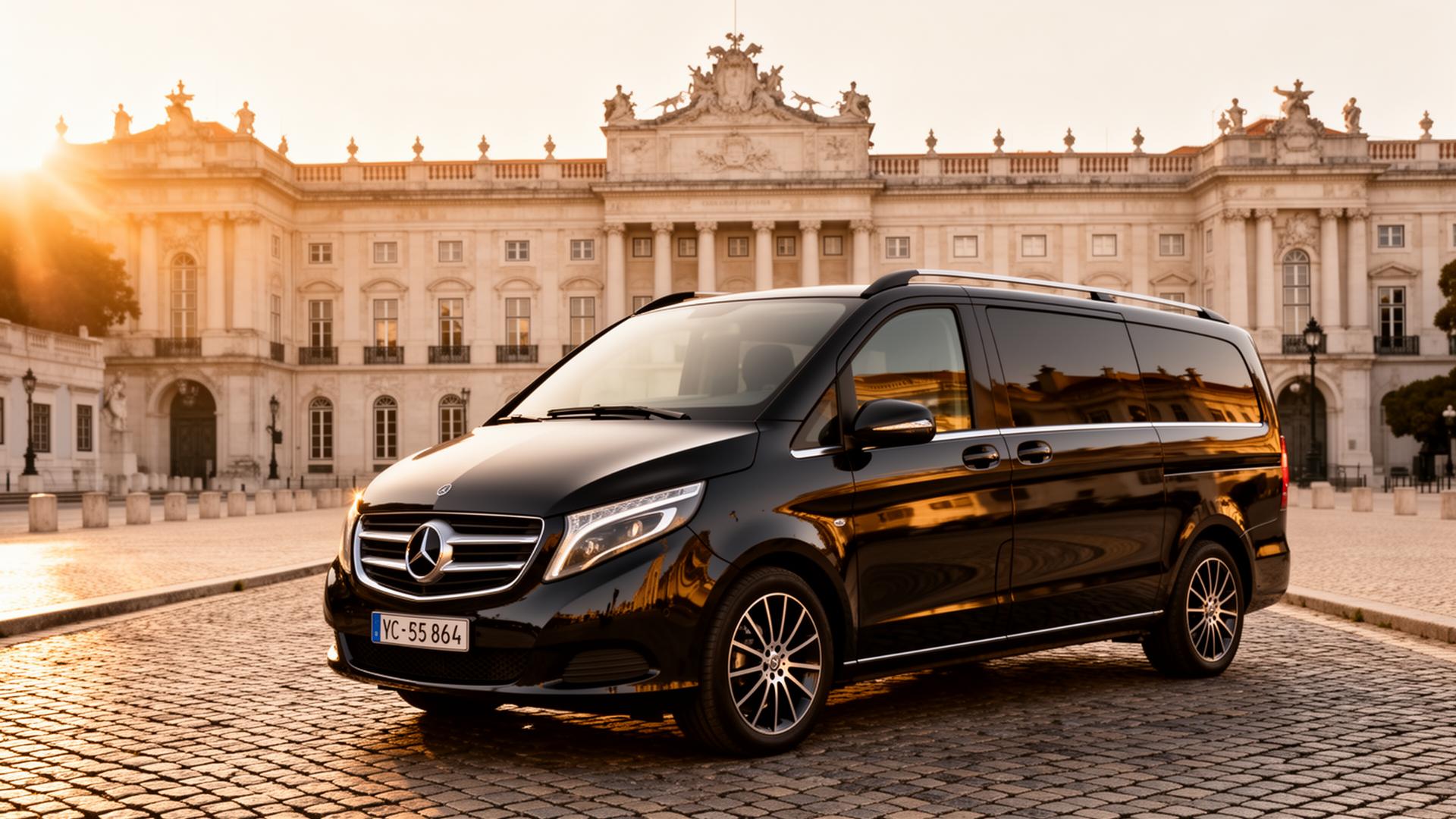
Hiring a vehicle for thirty people is easy. Knowing where that vehicle is allowed to stop, how long it may wait, and which streets it physically cannot enter is the part that decides whether your group has a good day or spends it standing on a pavement with the luggage.
We move private groups around Lisbon and Sintra every week of the season. What follows is the practical shape of it, including the parts that are inconvenient for us to tell you.
The vehicle is the easy part. The stopping is not.
Lisbon was built for mules. Alfama, Bairro Alto and much of Chiado are streets where a fifty-seat coach cannot go, and in several cases a minibus cannot turn round. If your hotel is up one of them, the honest answer is not a bigger vehicle but a shorter walk: we meet you at the nearest square where a coach may legally stand, and a car brings anyone who cannot manage the last two hundred metres.
This is worth settling before you book rather than at eight in the morning with the engine running. Send us your hotel and we will tell you exactly where the vehicle will be, and how far that is from your door.
Sintra changed its rules in July 2026
Sintra has spent years trying to keep traffic out of a village that was never designed to hold it, and the current rules are the strictest yet.
Since 8 July 2026, tourist coaches are no longer permitted along Volta do Duche, the road most groups used to arrive on. Larger vehicles are directed to Lourel and Ramalhão instead. There are designated pick-up and drop-off points around the historic centre, including near Pena and Quinta da Regaleira, and those points are where your group gets on and off.
Two consequences follow. Your group will walk further in Sintra than they would have done two years ago, and the timings of the day have to be built around where a vehicle may actually stand rather than where you would like it to.
Separately, and this catches almost everybody: the road up to Pena Palace cannot take a vehicle longer than about ten metres. That is roughly a twenty-five seater, so about twenty-three guests once the driver and guide are seated. A full-size coach can take fifty people beautifully along the coast to Cabo da Roca. It cannot take them to the gates of Pena. We have written about what that means for a large group tour in more detail.
Parques de Sintra also prohibits vehicles inside the park itself. From the main gate your group either walks up or takes the park shuttle, which is a few euros return per person. It is a small cost and a real one, and it belongs in your planning rather than in a surprise at the gate.
A group of forty does not arrive at once
On paper an airport transfer for forty people is one coach and one pick-up time. In practice they are on four flights from three cities, one of which is delayed, and two people are still at baggage reclaim forty minutes after everybody else.
There are three ways to handle it and they cost different amounts. A single vehicle that waits for everyone is cheapest and slowest, and the first arrivals will not thank you. Staggered vehicles by flight are the most comfortable and the most expensive. A hybrid, where the main group travels together and stragglers follow by car, is usually the sensible middle.
What matters is choosing deliberately rather than discovering the problem at Humberto Delgado on the morning. Send us the flight numbers, not just the date, and we will tell you which of the three your group actually needs.
Luggage decides the vehicle as much as headcount does
A fifty-seat coach has a hold underneath and will swallow fifty suitcases without complaint. A twenty-seat minibus generally does not, and luggage rides in the aisle or on laps.
So a group of eighteen with hand luggage and a group of eighteen arriving from a week in the Douro with full cases are not the same booking, even though the headcount is identical. Tell us whether this is a transfer with bags or a day out with handbags. It changes the vehicle, and occasionally it changes the price.
Boarding takes longer than anyone allows for
Four people get into a car in about a minute. Forty people board a coach in fifteen to twenty, and that is with everybody present and willing. Add a stop for photographs, a group that has spread out, or one person who has gone back for a jacket, and a schedule built on optimism starts to fail by the second stop.
We build large group days with real boarding times in them. It is why our itineraries for forty people have fewer stops than our itineraries for four, and why the ones that try to do everything are usually the ones that end up rushed.
Splitting a group across two vehicles
Above about twenty-three guests in Sintra you are in two vehicles, and somebody has to decide who travels where. Do it in advance and in writing. Families stay together, the group that wants the early start goes in one vehicle, and each vehicle has a named person who knows the plan.
Each vehicle also needs its own guide. A guide cannot narrate two coaches, and the second vehicle arriving guideless at Pena is a bleak experience for the people in it. If a quote for a large Sintra group lists one guide, ask how the second vehicle is being looked after.
Waiting, parking, and where the driver goes
Drivers cannot idle at the kerb in central Lisbon or in Sintra village. Once you are out and walking, the vehicle leaves and parks somewhere legal, which may be several minutes away.
This is normal and it is why pick-up times matter. If your group finishes lunch twenty minutes early and expects the coach to be waiting outside, it will not be. Agree the time, and if it changes, tell the guide as soon as you know rather than as you walk out.
Drivers also have legally mandated rest periods. On a long day, particularly one that runs to the Algarve or the Douro, those rests are not negotiable and they shape what is possible.
What a cheap quote is usually missing
Carrying paying passengers requires proper licensing and a motor policy that covers passengers for hire and reward. A private car policy does not, and an insurer will decline a claim on exactly that basis.
When a quote comes in noticeably below everybody else, it is worth asking three questions. Is the vehicle licensed to carry paying passengers, and can they show it? Does the vehicle they are sending physically fit the route, including the road to Pena? And who is looking after the second vehicle if there is one?
We would rather answer those questions than have you find the answers on the day.
What to send us when you ask for a quote
The more of this we have at the start, the faster the answer and the better the plan:
How many people, and how many are children or need step-free access. Your hotel or where the group is staying. The dates, and flight numbers if it involves an airport. Whether there is luggage. What you want to see, or simply that you do not know yet and would like a suggestion. And whether you have your own guide or would like us to arrange one.
You will get back a plan with the awkward parts named, rather than a price with the awkward parts hidden. Tell us about your group and we will work out how it actually runs.